

KEY POINTS
- Environmental investing involves investing for returns in projects or companies that benefit the environment.
- It is being driven by falling technology costs, infrastructure replacement and trillions of dollars in global capital deployment.
- The EnviroInvest Investment Fund gives wholesale investors diversified exposure across environmental assets.
Environmental investing is not a niche investment in an obscure corner of the economy. Trillions of dollars are being poured into the industry and it will be a major driver of returns over the coming decades. It provides exposure to structural changes in energy, industry, resource use and the valuation of environmental impacts.
In 2025, global energy-transition investment reached US$2.3 trillion. The global green economy has already surpassed US$5 trillion in market value and is projected to exceed US$7 trillion by 2030. Despite some negative political commentary, energy transition investment is surging ahead, even in the USA, as economics ultimately trumps politics.
Energy systems must be replaced, electricity networks upgraded and battery capacity expanded. This is creating opportunities across renewable infrastructure, storage, green debt, carbon markets, resource recovery, biodiversity and innovative environmental technologies.
But for the average Australian investor the difficulty is gaining diversified exposure without taking excessive risk or spending substantial time and money assessing individual opportunities. The EnviroInvest Investment Fund has been established to address this gap.
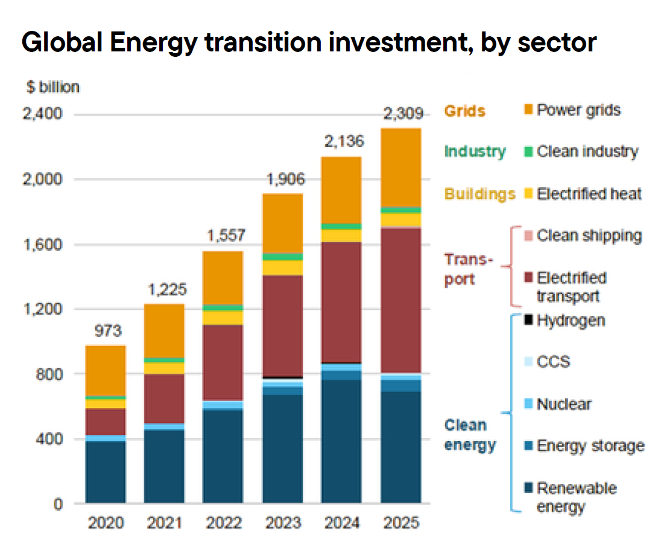
Figure 1: Global energy-transition investment by sector
Source: BloombergNEF. Note: CCS refers to carbon capture and storage.
The economics supporting environmental investing
The environmental transition is not being driven solely by climate targets. It is increasingly being supported by economics.
Solar and wind costs have fallen by approximately 80% since 2015, while battery deployment in 2025 was six times higher than in 2020. Lower technology costs are expanding the number of commercially viable projects and strengthening the investment case for the infrastructure supporting them.
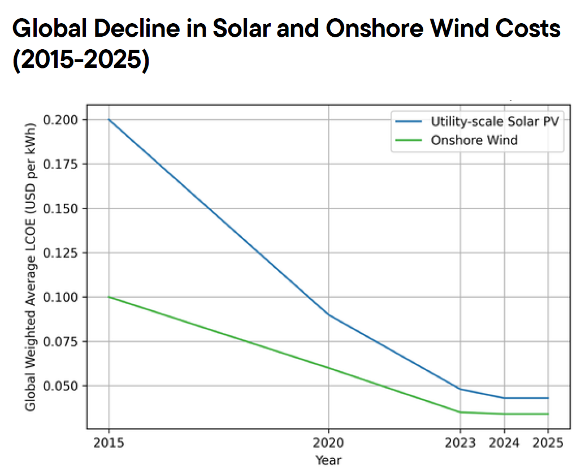
Figure 2: Decline in solar and onshore wind costs, 2015–2025
Source: International Renewable EnergyAgency (IREA), Renewable Power Generation Costs reports, various editions 2016 to 2025.
Australia has strong solar and wind resources, extensive land, established capital markets and proximity to the world’s future major energy consumer, Asia. Its ageing coal-fired power stations are in need of replacement. As renewable generation expands, investment will be required in storage, transmission, grid management and system reliability.
The EnviroInvest Investment Fund is positioning investors across this broader opportunity rather than limiting its focus to renewable generation alone.
Australia has projects and opportunities, but it still needs capital
Despite the size of Australia’s superannuation system, very little retirement capital is being invested directly into the renewable infrastructure and battery-storage projects driving the transition.
In its “Passing the Buck” report, Market Forces identified $99 billion of investment activity across 514 Australian renewable-energy and battery projects since 2020. Of those projects, 223 were operating, 60 were under construction or commissioning and 214 remained in development.
Yet Australia’s 30 largest superannuation funds contributed only $771 million in identified direct investment. That represented 0.8% of the capital invested across the projects examined and only 0.03% of the $2.5 trillion managed by those funds.
More than 96% of the identified superannuation investment related to acquisitions of existing assets or companies rather than financing new developments.
This capital gap creates an opportunity for specialist investment managers capable of identifying, assessing and funding suitable environmental assets. It also reinforces the role the EnviroInvest Investment Fund could play in connecting wholesale investors with opportunities that are often difficult to access through conventional portfolios.
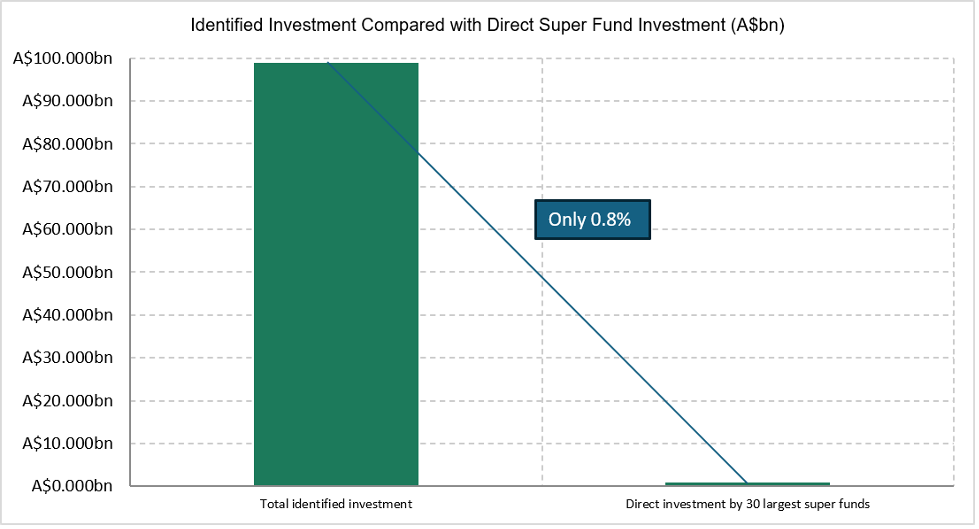
Figure 4: The Australian renewable-investment capital gap
Source: Market Forces “Passing the Buck” report 2026
A strong sector can still produce weak investments
The growth of environmental investing does not mean every project or company will succeed.
Renewable projects can face approval delays, grid-connection problems, construction overruns and volatile electricity prices. Innovative technologies may consume substantial capital for years before producing commercial revenue. Carbon and biodiversity markets can be affected by regulatory change, pricing uncertainty and questions over credit quality.
Liquidity is another risk. Many environmental assets are privately owned or unlisted. They may be difficult to sell, valuations may be less transparent and capital may need to remain invested for several years. Even listed environmental companies can be volatile, particularly when they depend on repeated capital raisings.
How EnviroInvest manages risk
Buying one battery developer, renewable company or emerging technology may look like environmental exposure. In practice, the investor becomes dependent on one management team, project, technology or funding pathway.
Building a diversified portfolio independently requires time and money. Investors must locate opportunities, undertake due diligence, assess management, negotiate access and monitor each asset. Deal flow can also be difficult because many environmental opportunities are privately negotiated.
The EnviroInvest Investment Fund provides wholesale investors with a more structured alternative. Rather than relying on one company or project, it seeks diversified exposure across renewable infrastructure, innovative technologies, green debt, carbon markets and abatement, the circular economy and biodiversity-related assets.
EnviroInvest’s investment process assesses opportunities for their financial prospects, environmental contribution, management quality, funding requirements, risks and suitability within the wider portfolio. The Fund can also access unlisted and specialist opportunities that individual investors may struggle to identify or enter directly.
This approach does not eliminate risk. Liquidity, valuation, execution and capital-loss risks remain, and environmental investments can require patience. However, the EnviroInvest Investment Fund reduces the reliance on “hit and hope” selection by combining professional management, continuing oversight and diversification across multiple environmental assets.
For wholesale investors seeking exposure to the environmental transition, EnviroInvest is offering a way to participate without having to find, assess and monitor every underlying opportunity themselves.
For more information about the EnviroInvest Investment Fund visit www.enviroinvest.com.au or contact fund manager Elio D’Amato.
 Elio D’Amato
Founder and Executive Chairman
www.enviroinvest.com.au
P: 1300 45 96 85
M: 0401 032 914
EnviroInvest Pty Ltd ACN 685 107 957 is an Authorised Representative of Daylight Financial Group Pty Ltd ACN 633 984 773 (AFSL 521404). This communication may contain general financial product advice. It has been prepared without taking into account your personal objectives, financial circumstances or needs. You should consider its appropriateness in light of those circumstances and obtain and consider the relevant Information Memorandum or Product Disclosure Statement before making any investment decision. Investments can rise or fall in value, and past performance is not a reliable indicator of future performance.